martes, 7 de noviembre de 2017

What are microexpressions?

We have heard them mentioned again and again in series such as Lie To Me, being "protagonists" in the art of determining if a person is lying or not; We know they have to do with the expressions of our face, but what are they really? How do they manifest?

The microexpressions are involuntary movements of the muscles of the face, in especially emotional moments and that are related to a situation that can cause us anxiety; either for positive or negative reasons. Currently, it has been determined that the seven basic emotions (Happiness, anger, sadness, surprise, contempt, fear and disgust) can not be "falsified", because the muscles of the face move, in most cases, automatically, and there is no way we can reproduce those movements in a perfectly conscious way, even with a lot of practice. Even professional actors, whose work is precisely in that falsification, could not be more effective than those not initiated in the performing arts if they face a situation of imminent danger or deep emotional stress, because their reaction will be as primary as ours. .
Automatic and involuntary

The microexpressions are not called precisely because they are very small, but because their duration in the human face is incredibly short (approximately one twentieth of a second). At such speed, and combining it with conversation, body movements, manual gestures and lighting (all the elements that distract), it is very possible to ignore them. That is why for a true study of those micromotions, it is necessary to film the subject in high definition, so that we have the possibility to see the recording again and again, if possible, frame by frame.


To facilitate its study, Paul Ekman, an American scientist, created the Facial Action Coding System (FACS), which is a method for classifying the movements associated with the muscles of the face. Since the combination of the movements of the individual muscles would be a titanic but impractical task, Ekman decided to group the muscles into "groups" or units of action, in such a way that their classification was easier. Of course, the phrase "easier" is a euphemism that falls short, because even with this simplified approach it is possible to count more than 10,000 different facial expressions.


The "Wizards Project"
Ekman carried out an investigation called "The Wizards Project (magicians)", later called Project Diogenes. It was to determine what percentage of the population was able, in a natural way, to determine at a glance if a person is lying or not. The so-called "Magicians" that determined the study, were those people who could locate lies with an effectiveness greater than 80% (presumably for its facility to detect microexpressions in a natural way), while an ordinary person is not much better than a person. 50% random The study revealed that only 0.0025% of the population has this ability, because of 20,000 people studied, only 50 met the criteria. Facts like this have helped to feed the "myth" of mentalists who are able to read people's minds, when in reality they are simply individuals with an excellent capacity for observation.

Practice makes a master
There is also an online tool called Micro Expression Training Tool (METT) which is a very simple flash application where we can learn about microexpressions and the different types of emotions, which muscles are involved in which manifestation and practices or "drills" to review our abilities. Obviously, as we move with the tool, it becomes progressively more difficult; and on the other hand, the exercises that previously seemed impossible to us begin to be solved with great ease, since our brain is getting used to seeing precise areas of the face that are common to several emotions.

Current applications

The study of facial microexpressions has proved its worth in many different fields such as criminology, psychology, medicine and even 3D character animation.

miércoles, 1 de noviembre de 2017

Hanging

Hanging, according to Tardieu is defined as an act of violence in which the body taken by the neck in a tie tied to a fixed point and left to its own weight, exerts on the suspender loop a strong enough traction to produce abruptly the loss of knowledge, the arrest of vital functions and death.


The anoxemia by hanging is aided by its ease of handling, since it is easy to get a rope and a link where to hang it. For death to occur, it is enough that part of the subject is hung and not the whole person, some people have been found with knees on the floor or even semi-sitting. This is achieved because only 2 kg is necessary to obliterate the jugular veins, 5 kg to obliterate the carotid arteries, 15 kg to obstruct the trachea and 25 kg to suppress the permeability of the vertebral arteries.

There are hanging by suicide, accident, judicial execution, suicide is the most common, the accidental is given by children playing the "hanged". The judicial is by judicial order or death penalty. The crimes are often masked by resorting to "suspension" leaving the authority thinking that it is suicide. Suspension is a term used only for corpses that are hanged, but died of something else. If he has not died from anoxemia, Tardieu's spots are not found in the suspended.

Mechanism of death:

When the knot is in the mouth or under the chin and the rope slides well, the occlusion of the vessels and airways occurs rapidly, leading to rapid death, producing a pale face. If the knot is on one of the sides, it is seen in front of the ear, and the vessels on the opposite side are semipermeable, congestion occurs due to the suppression of the venous return, producing the cyanosed face.

When the knot is below the chin the head is back

When the knot is in the neck the head is forward.

Symptomatology of the hanged: Three periods are considered

'Hanging'
1. Anesthesia: presents the following symptoms


Heat sensation in the head

Ringing ears

Visual disturbances

Brain clumsiness

Intense pain in the neck

Loss of consciousness

2. Convulsive period:

Contractions of the muscles of the face (grimaces)

Uneven movements of upper and lower limbs: can cause injury to the subject

3. Final period due to anoxemia:

Precedes death

He can be removed and with care he will come back to life for a few hours, but he will die from the effects of the shock or hypostatic pneumonia

When it comes to the emission of urine and feces, it is impossible for him to live

Death is prevented by artificial respiration and if there is no damage to bodies or spinal cord.

Autopsy:

Pale face color, muscle tone and tongue position have little value.

The groove must be carefully studied: its direction, shape, appearance, consistency and depth. If the bond is hard and thin, the groove will be deeper, well-limited edges and the marked permeation of the dermis. It is considered a hard groove. If the material used is a belt, the groove will be soft.

There are unique, double and rarely triple grooves, depending on the number of bends of the loop or the number of these. The grooves below the larynx are rare.

The grooves can be:

Incomplete, complete
 
Oblique from front to back and from bottom to top, leaving the highest part in the knot

The bottom of the sulcus is pale and cyanosed by blood plasma.

The lower edge less marked unlike the upper part of the groove, there are ecchymosis and blood disorders, there is tearing of the carotids, and blood may be spilled in the area. There is dislocation or fracture of cervical vertebrae.

In thorax, there is pulmonary congestion, subpleural emphysema and bronchi full of mucus.

The brain is congested or ischemic, according to the handles around the neck


The diagnosis about the cause can give us data on whether the hanging is the cause of death, or if it is a suicide, a crime or an accident.

Branches of Criminalistics

Within the criminology there are technical applications of the work of different disciplines, auxiliary sciences and expert laboratories, among which are:

· Forensic anthropology: is the application of the science of Physical Anthropology to the legal process. To be able to determine the sex, size, age, ethnic group, and even reach the facial reconstruction of human remains. To be able to determine the sex, size, age, ethnic group, and even reach the facial reconstruction of human remains.

·Forensic ballistics: science that analyzes the firearms used in the crimes. It usually includes the study and analysis of projectiles and impacts determining the caliber of the fired weapon.

·Dactiloscopy: is the set of techniques and procedures that have as purpose the study and classification of fingerprints; using powders, iodine vapors, sodium cyano-acrylate or by means of the laser beam.

·Documentscopy: discipline related to the practical and methodical application of scientific knowledge, with the purpose of verifying the authenticity or determining the authorship of the documents.

·Hair and fiber study: Through chemical study it can be determined if the hair in the study is about human or animal hair, as well as other characteristics.

·Forensic Photography: The participation of the photographer to make the photographic fixation of the scene and everything related to it is fundamental; however, it is only the first part of his work, since later he will have to go to the forensic photography laboratory to carry out the development of the material with which the opinions will be illustrated.

·Forensic genetics: The study of biological material, such as saliva, semen, blood, hair, and other tissues, allows the typing of deoxyribonucleic acid (DNA), a modern identification method that, due to its great precision, has been called genetic fingerprinting.

Hematology: In this specialty the application of chemistry is essential if a stain that was found in the place of the fact is blood and if it is animal or human; in the case of human blood, the groups, subgroups and the RH factor will be determined.

·Forensic Medicine: If it is considered that the laboratory is the place where scientific research works are carried out, either the necrocomium or the Forensic Medical Services can be estimated as the laboratories that the doctors use for the thorough study of the corpse, and to determine their identity and cause of death.

·Forensic dentistry: is the application of dental knowledge for identification purposes and useful in Labor, Civil and Criminal Law. It is the branch of dentistry that deals with the management and proper examination of dental evidence and the assessment and presentation of dental findings, in the interest of justice.

·Forensic chemistry: It is the branch of Chemical Science that is in charge of the analysis, classification and determination of those elements or substances that were found in the place of the facts or that could be related to the commission of an illicit.

·Forensic toxicology: is the branch of toxicology that studies the methods of medical-legal investigation in cases of poisoning and death.

sábado, 16 de septiembre de 2017

The Victimology

Victimology as a discipline (Mendelsohn) was born of criminology, after the Second World War, in order to deal with the scientific study of the victims, in response to the fact that both law, criminology and even forensic psychology were had focused only on the offender or offender, paying little attention to the aggrieved party.

Classification and types of victims (Landrove)

1.- Non-Participating Victims (or Fungible): also called entirely innocent or ideal. His intervention does not trigger the criminal act; the relationship between the offender and the victim is irrelevant. In turn, within this category are distinguished between accidental and indiscriminate victims. The former are replaced by chance in the path of criminals, as is the case, for example, of the client who is on a bench at the time of an armed robbery, or who suffers a violation derived from the reckless driving of an inebriated person. The latter comprise an even broader sector than the previous one, since at no time supports any link with the culprit. The traditional example is the anti-terrorist, in which there are often no personal reasons against the injured (collateral damage).

2.Participant Victims (or Infungibles): play a certain role in the origin of crime, voluntarily intervening or not, in the criminal dynamics. This is the case in some cases of unpredictability of the victim (when he does not close the access roads to the home, leaves a valuable object in the vehicle, walks into the night through a dangerous neighborhood, etc.). intervention is more decisive, provoking the event, which arises as retaliation or revenge against his performance. Likewise, there is talk of alternative victims, alluding to those who voluntarily stand in a position of being, depending on chance as a victim or victimizer (as in a duel or fight). Finally, the greatest contribution occurs in the case of voluntary victims, who instigate the crime or freely agree (euthanasia, homicide, suicide ...)

3. Family Victims: they belong to the family nucleus of the offender, and are in a situation of special vulnerability because of their living or domestic relationship with him (which in turn explains the wide "black figure" of the crimes produced in this environment) . Abuse and sexual assault in the home mainly have the weakest members as the passive object: women and children.

4. Collective Victims: In crimes that harm or endanger certain assets whose ownership does not correspond to a natural person, but to a legal entity, the community or the state: financial crimes, consumer fraud, computer crime, and other frauds of what is often called white-collar crime. In all these infractions, it is worth noting the depersonalization, collectivization and anonymity with respect to the relationships between offender and offender.

5. Especially Vulnerable Victims: those subjects who for various reasons offer a specific victimogenic predisposition. These circumstances include age, as it is often harder for children and the elderly to provide effective resistance. Also the physical or psychic state of the subject, due to the greater weakness caused by certain diseases and disabilities; race, which motivates the victimization of some minorities; and sex, being generally female the victim of certain crimes produced in the family environment, labor, etc. Homosexuality is at the base of some infractions (blackmail, physical aggression ...). There are also social factors that provide this greater victimization: the economic position, the lifestyle, the location of the house, the treatment of marginal groups, etc., as well as the risk inherent in the exercise of some professions (policemen, , employees of banks, pharmacists ...), and particularly the practice of prostitution.

6. Symbolic victims: some people suffer acts aimed at undermining a certain system of values, political party, ideology, sect or family, to which the aggrieved belongs, being a representative element of them; the murders of Martin Luther King or Aldo Moro are often cited as examples.

7. False victims: they denounce in crime that in fact it has not existed, offering a double modality: simulators, who act consciously putting the process in order in order to provoke a judicial error; e, imaginary, who mistakenly believe (for psychological reasons, or psychic immaturity) to have suffered a criminal act.
In conclusion, we could roughly consider how a physical / behavioral interaction, observable and multivariable, that for its commission needs the "criminal or criminal couple" composed of the actions and omissions of both the aggressor or the victimizer, as well as the victim in question.

Thus the study of the victim (from the Latin "defeated") for the forensic psychology, is particularly important as far as the "participant or triggering role" that corresponds to them. Psychologists, as well as professionals in the field of forensics, authorities and even citizens, should be aware of the causal relationship that exists between the occurrence of the crime and the contribution of the aggrieved in their victimization, for which and for the analysis of behavior criminal, it is essential the technical exercise of being able to determine what are the contributions of both the aggressor and the victim in the criminal act.


The word victim does not have a unique meaning, but is attributed different meanings according to the context in which it is used, so that sometimes it is synonymous with aggrieved or offended by crime, while in others it is presented in a more loose and considers any person (natural and legal) or number of these who suffer from natural or human causes.

sábado, 15 de abril de 2017

Diferencia entre Criminalística y Criminología

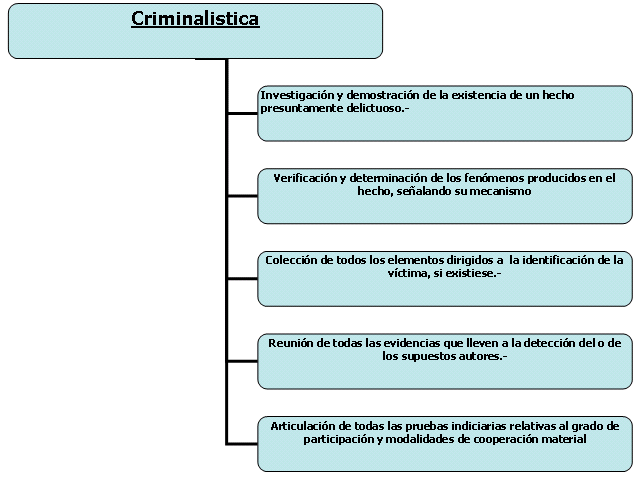
Criminalística es la disciplina que aplica fundamentalmente los conocimientos, métodos y técnicas de investigación de las ciencias naturales en el examen de material sensible significativo relacionado con un presunto hecho delictuoso, con el fin de determinar, en auxilio de los órganos de administrar justicia, su existencia, o bien reconstruirlo o bien señalar y precisar la intervención de uno o varios sujetos en el mismo.-

Siendo el estudio de los hechos físicos relacionados con un delito o crimen, realizado para ayudar al investigador en la identificación y reconstrucción del hecho. La mayoría de las disciplinas científicas se ocupan de lo que es común o usual, se relacionan con lo que es poco común e inusitado.-

Para Montiel Sosa "La Criminalistica es una ciencia penal auxiliar, que mediante la aplicación de sus conocimientos, metodología y tecnología, al estudio de las evidencias materiales, descubre y verifica científicamente la existencia de un hecho presuntamente delictuoso y al o los responsables aportando las pruebas a los organos que procuran y administran justicia".-

La Criminología, como ciencia, es una ciencia práctica.-
Criminología: La Criminología puede definirse como la disciplina científica que tiene por objeto el estudio de los factores del delito, de las conductas desviadas relacionadas con él, del delincuente y de su víctima.

La Criminología es una Ciencia. Aporta una información válida, fiable y contrastada sobre el problema criminal; información obtenida gracias a un método (empírico) que descansa en el análisis y observación de la realidad. En consecuencia, la cientificidad de la Criminología solo significa que esta disciplina, por el método que utiliza, está en condiciones de ofrecer una información viable y fiable (no refutada) sobre el complejo problema del crimen, insertando los numerosos y fragmentarios datos obtenidos del examen de éste en un marco teórico definido. es una ciencia Causal-Explicativa, Empírica eInterdisciplinaria,

La Criminología adquirió autonomía y rango de ciencia cuando el Positivismo generalizó el empleo del Método Empírico, esto es, cuando el análisis, la observación, y la inducción sustituyeron a la especulación y el silogismo, superando el razonamiento abstracto, formal y deductivo del mundo clásico. Someter la imaginación a la observación y los fenómenos sociales a las leyes implacables de la naturaleza era una de las virtudes según Comte, del método positivo, del método empírico.
La Criminología es una ciencia del "ser", Empírica; el derecho, una ciencia cultural del "deber ser".
Normativa

Pertenezca al ámbito de las ciencias empíricas significa, en primer lugar; que su objeto (delito, delincuente, víctimas y control social) se inserta en el mundo de lo real, de lo verificable, de lo mensurable y no en el de los valores. La naturaleza Empírica de la Criminología implica, ante todo, que ésta descansa más en hechos que en opiniones, más en la observación que en discursos o silogismos.


lunes, 17 de octubre de 2016

La Victimologia


La victimología como disciplina (Mendelsohn) nace ligada a la criminología, tras la 2ª guerra mundial, con el objeto de ocuparse del estudio científico de las víctimas, esto en respuesta a que tanto el derecho, como la criminología e incluso la psicología forense, se habían centrado solamente en el agresor o delincuente, prestando escasa atención a la parte agraviada.

Clasificación y tipos de las víctimas (de Landrove)

1.- Víctimas no Participantes (o Fungibles): también denominadas enteramente inocentes o ideales. Su intervención no desencadena el acto criminal; la relación entre el infractor y la víctima es irrelevante. A su vez, dentro de esta categoría se distinguen entre víctimas accidentales e indiscriminadas. Las primeras son sustituidas por el azar en el camino de los delincuentes, como es el caso, por ejemplo, del cliente que se encuentra en un banco en el momento de consumarse un asalto a mano armada, o de quien sufre un atropello derivado de la conducción imprudente de una persona ebria. Las segundas integran un sector incluso más amplio que el anterior, al no sustentar en ningún momento vínculo alguno con el culpable. El ejemplo tradicional los constituyen los antentados terroristas, en los que con frecuencia no existen motivos personales en contra los agraviados (daño colateral).

2. Víctimas Participantes (o Infungibles): desempeñan cierto papel en el origen del delito, interviniendo voluntariamente o no, en la dinámica criminal. Así sucede en algunos casos de imprevisión de la víctima (cuando no cierra las vías de acceso al hogar, deja a la vista un objeto valioso en el vehículo, camina a altas horas de la noche por un barrio peligroso, etc.) Otras veces su intervención es mas decisiva, provocando el suceso, que surge como represalia o venganza contra su actuación. Asimismo, se habla de las víctimas alternativas, en alusión a aquellas que se sitúan voluntariamente en posición de serlo, dependiendo del azar su condición de víctima o de victimario (como sucede en algún duelo o pelea). Finalmente, la mayor contribución se produce en el supuesto de las víctimas voluntarias, que instigan el delito o lo pactan libremente (eutanasia, homicidio, suicidio…)

3. Víctimas Familiares: pertenecen al núcleo familiar del infractor, y se encuentran en una situación de especial vulnerabilidad por su relación convivencial o doméstica con aquél (lo que a su vez explica la amplia “cifra negra” de los delitos producidos en este entorno). Los malos tratos y las agresiones sexuales en el hogar tienen principalmente como objeto pasivo a los miembros más débiles: las mujeres y los niños.

4. Víctimas Colectivas: en delitos que lesionan o ponen en peligro determinados bienes cuya titularidad no corresponde a una persona natural, sino a una persona jurídica, a la comunidad o al estado: delitos financieros, fraudes al consumidor, delitos informáticos, y otras defraudaciones de lo que suele denominarse delincuencia de cuello blanco. En todas estas infracciones destaca la despersonalización, colectivización y anonimato respecto a las relaciones entre delincuente y ofendido.

5. Víctimas Especialmente Vulnerables: aquellos sujetos que por diversos motivos ofrecen una predisposición victimógena especifica. Entre esas circunstancias se encuentra la edad, ya que a los niños y ancianos les suele resultar más difícil ofrecer una resistencia eficaz. También el estado físico o psíquico del sujeto, debido a la mayor debilidad provocada por ciertas enfermedades y minusvalías; la raza, que motiva victimización de algunas minorías; y el sexo, siendo generalmente mujer la víctima de ciertos delitos producidos en el entorno familiar, laboral, etc. La homosexualidad se encuentra en la base de algunas infracciones (chantajes, agresiones físicas…). Asimismo existen factores sociales que proporcionan esa mayor victimización: la desahogada posición económica, el estilo de vida, la ubicación de la vivienda, el trato con grupos marginales, etc., amen del riesgo inherente al ejercicio de algunas profesiones (policías, vigilantes, taxistas, empleados de entidades bancarias, farmacéuticos…), y particularmente el ejercicio de la prostitución.

6. Víctimas simbólicas: algunas personas sufren actos dirigidos a menoscabar un determinado sistema de valores, partido político, ideología, secta o familia, a los que pertenece el agraviado, siendo un elemento representativo de los mismos; los asesinatos de Martin Luther King o Aldo Moro suelen ser citados como ejemplos.

7. Falsas víctimas: denuncian en delito que en realidad no ha existido, ofreciendo una doble modalidad: simuladoras, que actúan conscientemente poniendo en marcha el proceso con el fin de provocar un error judicial; e, imaginarias, que creen erróneamente (por causas psicológicas, o por inmadurez psíquica) haber sufrido un acto criminal.
En conclusión, a grandes rasgos podríamos considerar al delito cómo una interacción física/conductual, observable y multivariable, que para su comisión necesita de la “pareja delictual o criminal” compuesta por las acciones y omisiones tanto del agresor o victimario, como de la víctima en cuestión.

Asi que el estudio de la víctima (del latin “vencido“) para la psicología forense , resulta particularmente importante en cuanto al “rol participante  o desencadenante” que le compete a las mismas. Tanto psicólogos, como los profesionales del ámbito forense, las autoridades e inclusive la ciudadanía, deben ser conscientes de la relación causal que existe entre la ocurrencia del delito y la contribución del agraviado en su victimización, por lo cual y para el análisis de la conducta criminal, resulta primordial el ejercicio técnico de poder determinar cuales son las aportaciones tanto del agresor, como de la víctima en el hecho criminal.

La palabra víctima no tiene un significado único, sino que se le atribuyen diferentes acepciones según el contexto en el que se emplea, de modo que en ocasiones es sinónimo de agraviado u ofendido por el delito, mientras que en otros se presenta en un sentido más holgado y considera a cualquier persona (natural y jurídica) o número de estas que sufren por causas naturales o humanas.

viernes, 7 de octubre de 2016

Ramas de la Criminalistica

Dentro de la criminalística existen aplicaciones técnicas propias del trabajo de diferentes disciplinas, ciencias auxiliares y laboratorios periciales, entre los que se encuentran:
 
·         Antropología forense: es la aplicación de la ciencia de la Antropología Física a el proceso legal. Para poder determinar el sexo, talla, edad, grupo étnico, e incluso llegar a la reconstrucción facial de restos humanos.Para poder determinar el sexo, talla, edad, grupo étnico, e incluso llegar a la reconstrucción facial de restos humanos.
·      
Balística forense: ciencia que analiza las armas de fuego empleadas en los crímenes. Suele abarcar el estudio y análisis de los proyectiles y de los impactos determinando el calibre del arma disparada.
·      
Dactiloscopía: es el conjunto de técnicas y procedimientos que tienen como propósito el estudio y la clasificación de las huellas digítales; utilizando polvos, vapores de yodo, ciano-acrilato de sodio o por medio del rayo láser.
·      
Documentoscopía: disciplina relativa a la aplicación práctica y metódica de los conocimientos científicos, teniendo como objetivo verificar la autenticidad o determinar la autoría de los documentos.
·      
Estudio de pelos y fibras: Por medio del estudio químico puede determinarse si el pelo en estudio se trata de pelo humano o de animal, así como otras características.
·      
Fotografía forense: La participación del fotógrafo para realizar la fijación fotográfica de la escena y todo lo relacionado con la misma es fundamental; sin embargo, es sólo la primera parte de su trabajo, ya que posteriormente tendrá que trasladarse al laboratorio de fotografía forense para llevar a cabo el revelado del material con el que serán ilustrados los dictámenes.
·      
Genética forense: El estudio de material biológico, como la saliva, semen, sangre, pelo, y otros tejidos, permiten tipificar el ácido desoxirribonucléico (ADN), método identificatorio moderno y que por su gran precisión se ha denominado huella genética.
·      
Hematología: En esta especialidad la aplicación de la química es fundamental si una mancha que se halló en el lugar del hecho es sangre y si ésta es de animal o humana; en caso de tratarse de sangre humana se determinarán los grupos, subgrupos y el factor RH.
·      
Medicina forense: Si se considera que el laboratorio es el lugar en donde se realizan trabajos de investigación científica, bien puede estimarse el necrocomio o a los Servicios Médicos Forenses como los laboratorios que utilizan los médicos para el estudio minucioso del cadáver, y para determinar su identidad y causa de muerte.
·      
Odontología forense: es la aplicación de los conocimientos odontológicos con fines de identificación y de utilidad en el derecho Laboral, Civil y Penal. Es la rama de la odontología que trata del manejo y el examen adecuado de la evidencia dental y de la valoración y la presentación de los hallazgos dentales, en interés de la justicia.
·      
Química forense: Es la rama de la Ciencia Química que se encarga del análisis, clasifi­cación y determinación de aquellos elementos o sustancias que se encontraron en el lugar de los hechos o que pudieran relacionarse con la comisión de un ilícito.
·      
Toxicología forense: es la rama de toxicología que estudia los métodos de investigación medico-legal en los casos de envenenamiento y muerte.